Rated excellent on Google
Free shipping over €70
Over 7,500 satisfied customers





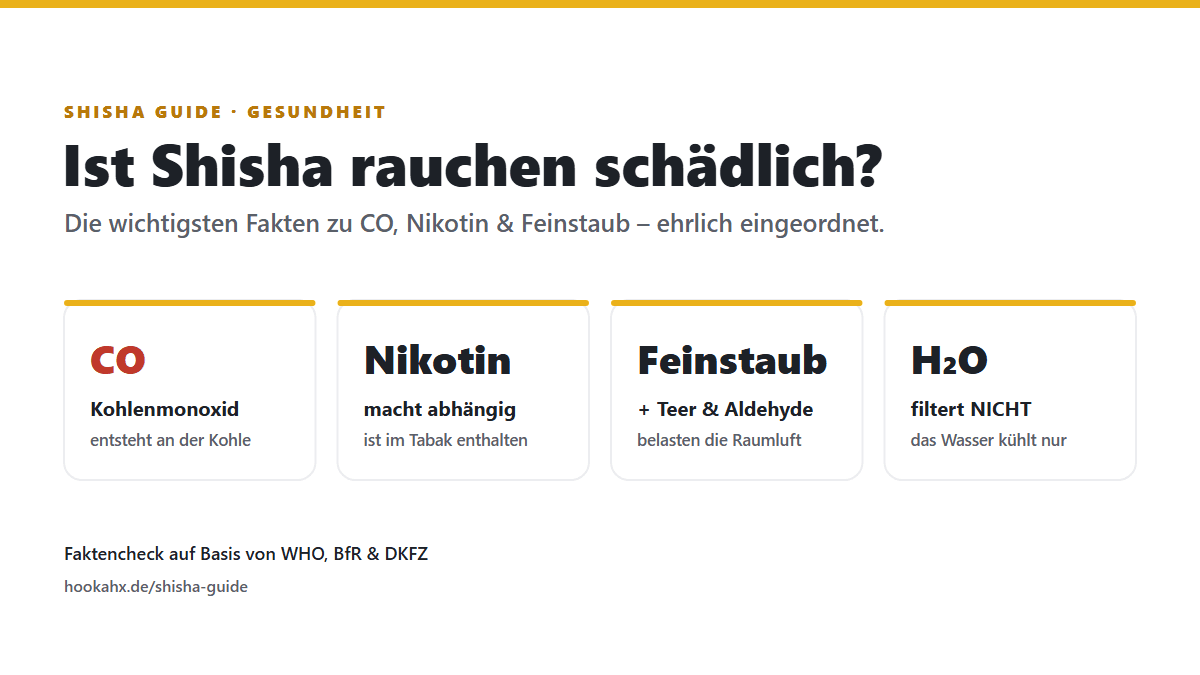
Short & honest: Yes, Smoking shisha is harmful – it is not a harmless alternative to cigarettes. The smoke contains Carbon monoxide, nicotine, tar, fine dust, aldehydes and heavy metals. The Water only cools the smoke, it does not filter out the pollutants. The greatest acute risk is Carbon monoxide from coal – dangerous especially in poorly ventilated rooms. Anyone who smokes can reduce the risk (ventilate well, use their own mouthpiece, heat without charcoal), but the only way to completely eliminate it is to avoid smoking.
“Is shisha actually harmful?” – you hear this question in almost every round. You often hear half-knowledge about this: “The water filters everything” or “It’s much more harmless than smoking”. In this guide we organize them Facts honestly – without scaremongering, but also without trivializing. You'll find out what's really in the smoke, how shisha compares to cigarettes and how you can realistically reduce the risk.
Yes. Waterpipe smoking is considered harmful to health by major health authorities. The World Health Organization (WHO), the German Cancer Research Center (DKFZ) and that Federal Institute for Risk Assessment (BfR) independently come to the same conclusion: shisha is not harmless and not a “healthier” option for smoking.
Nevertheless, a flat comparison “one shisha = X cigarettes” falls short. Amount consumed, type of tobacco, charcoal and ventilation make a big difference. Let's look at each of the factors.
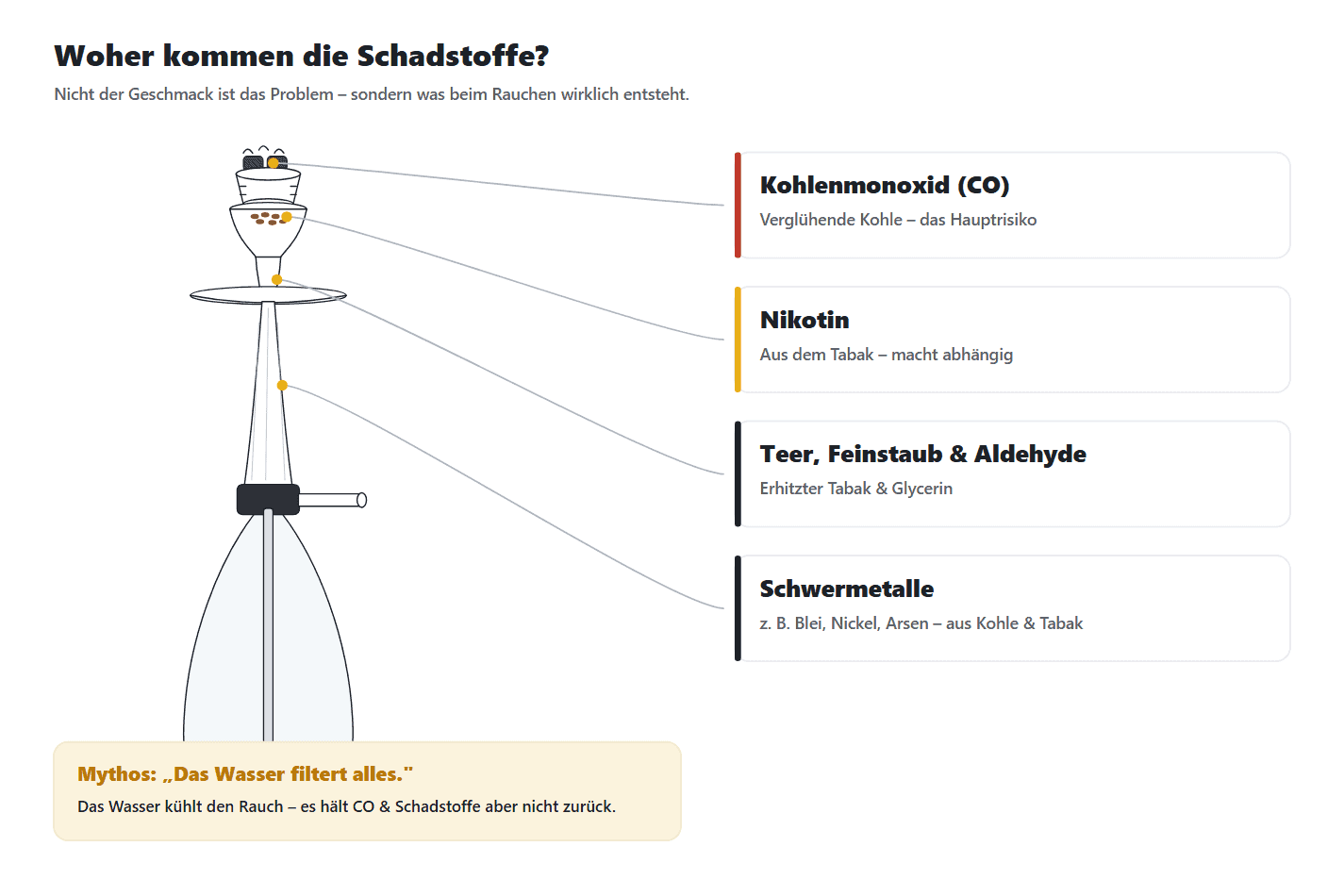
Even if it's just tobacco heated and not burned (more on this in the guide How does a shisha work?), numerous problematic substances are created. The most important are:
A shisha session is completely different than a cigarette: it lasts longer, has many more puffs and often takes place indoors. That’s exactly what makes the difference – not “one move”.
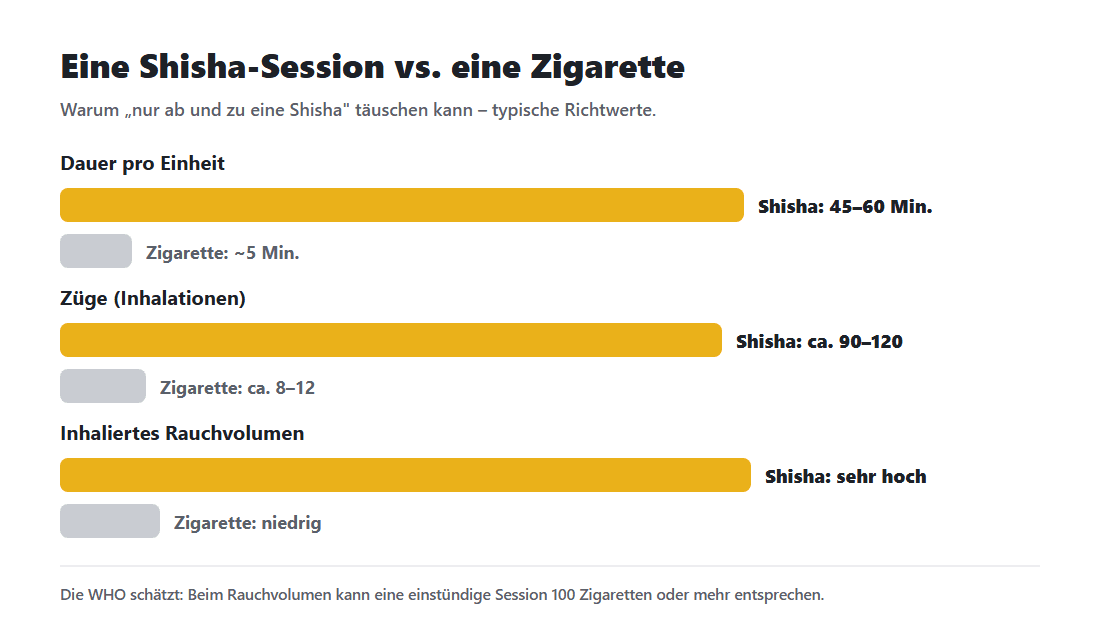
| feature | Shisha (one session) | cigarette (one piece) |
|---|---|---|
| Length of time | 45-60 minutes | about 5 minutes |
| Trains (inhalations) | approx. 90-120 | approx. 8-12 |
| Smoke volume inhaled | very high (according to WHO up to 100 cigarettes or more) | low |
| Carbon monoxide | high – especially from coal | available |
| nicotine | yes (depending on the type of tobacco) | Yes |
| Consumption setting | often indoors, in a group, sitting for long periods of time | usually short, often outside |
Perhaps the most important shisha-specific risk is Carbon monoxide (CO) – a colorless and odorless gas that occurs when Burning of the coal arises. The BfR warns expressly Carbon monoxide poisoning from shisha smoking, especially in closed, poorly ventilated rooms.
Typical warning signs of CO poisoning are: Headache, dizziness, nausea, racing heart up to unconsciousness. Important: CO is created regardless of tobacco - So even with tobacco-free varieties, as long as you smoke with charcoal.
Yes. Hookah tobacco contains nicotine, the addictive substance. How strong depends on the variety: Virginia tobacco contains comparatively little, stronger Dark Blend significantly more. Anyone who smokes regularly can Nicotine addiction develop - just like with cigarettes.
Too much nicotine at once can cause... Nicotine shock occur (dizziness, nausea, racing heart). We explain more about this in Shisha lexicon.
The most persistent misconception is: “The water filters the smoke and makes it harmless.” That's not true. The water cools the smoke and binds a small part of the particles - but it does not retain most pollutants. Carbon monoxide It is practically impossible to filter through water.
Tobacco-free alternatives such as Steam stones or Steam paste are often sold as harmless - that is too optimistic. Two distinctions are important:
So tobacco-free can do that nicotine reduce, but do not eliminate, all risks - especially not the CO from coal.
The only truly risk-free option is not to smoke. However, if you still smoke, you can noticeably reduce the risk:
The last point in particular switches this off greatest acute risk (CO from coal) specifically. The electric one XKAH Pro heats the tobacco with a heating head instead of coal Original price was: 329,90€.299,00€Current price is: 299,00€.. Important & honest: Nicotine and aerosol remainif you continue to use tobacco. Carbon-free means “without carbon monoxide”, not “healthy”.
The electric XKAH Pro heats the tobacco using a heating head instead of glowing coal - prices live and updated daily.
 XKAH Pro - Graphite Shisha Smokebox Original price was: 329,90€.299,00€Current price is: 299,00€.Watch now
 XKAH Pro - Graphite - Electric Smokebox + Battery Pack Original price was: 409,80€.360,00€Current price is: 360,00€.Watch now
You can find all colors & sets in XKAH-Pro brand shop. More about the principle in the guide Electric Shisha & XKAH.
Yes. Smoking shisha is proven to be harmful and is not a harmless alternative to cigarettes. The smoke contains carbon monoxide, nicotine, tar, particulate matter, aldehydes and heavy metals. The World Health Organization (WHO), the German Cancer Research Center (DKFZ) and the Federal Institute for Risk Assessment (BfR) classify waterpipe smoking as harmful to health.
You often consume significantly more smoke per session than with a single cigarette: a shisha session lasts 45-60 minutes with around 90-120 puffs, a cigarette only a few minutes with around 8-12 puffs. According to the WHO, the volume of smoke inhaled in a one-hour session can be equivalent to 100 cigarettes or more. However, a direct 1:1 comparison of toxicity is not serious - both are harmful.
No, that's a myth. The water cools the smoke and binds some of the particles, but does not retain most of the pollutants. Carbon monoxide and many other toxic substances reach the lungs despite water.
Carbon monoxide (CO) is mainly produced when coal burns, not from tobacco. This is why CO pollution is particularly dangerous in poorly ventilated rooms. The BfR warns of carbon monoxide poisoning from smoking shisha indoors.
Yes. Hookah tobacco contains nicotine, which is addictive. How much depends on the variety: Virginia tobacco contains less, strong dark blend contains significantly more. Some tobacco-free varieties (e.g. certain vaping pastes) also contain nicotine.
No. Tobacco-free or nicotine-free does not mean harmless. If you continue to smoke with coal, carbon monoxide is still produced, and when glycerin is heated, aldehydes such as formaldehyde are formed. Tobacco-free reduces nicotine but does not eliminate all risks.
It's only completely risk-free if you don't smoke. Anyone who smokes should: never smoke in closed, poorly ventilated rooms, ensure good ventilation, use their own mouthpiece, do not overdo sessions and pay attention to glowing natural charcoal. Electric heating without coal (e.g. XKAH Pro) switches off the source of carbon monoxide - but nicotine and aerosol remain with tobacco.
Note: This article is for general information and does not replace medical advice. Tobacco products are sold exclusively to people aged 18 and over. The healthiest choice is not to smoke.