Rated excellent on Google
Free shipping over €70
Over 7,500 satisfied customers





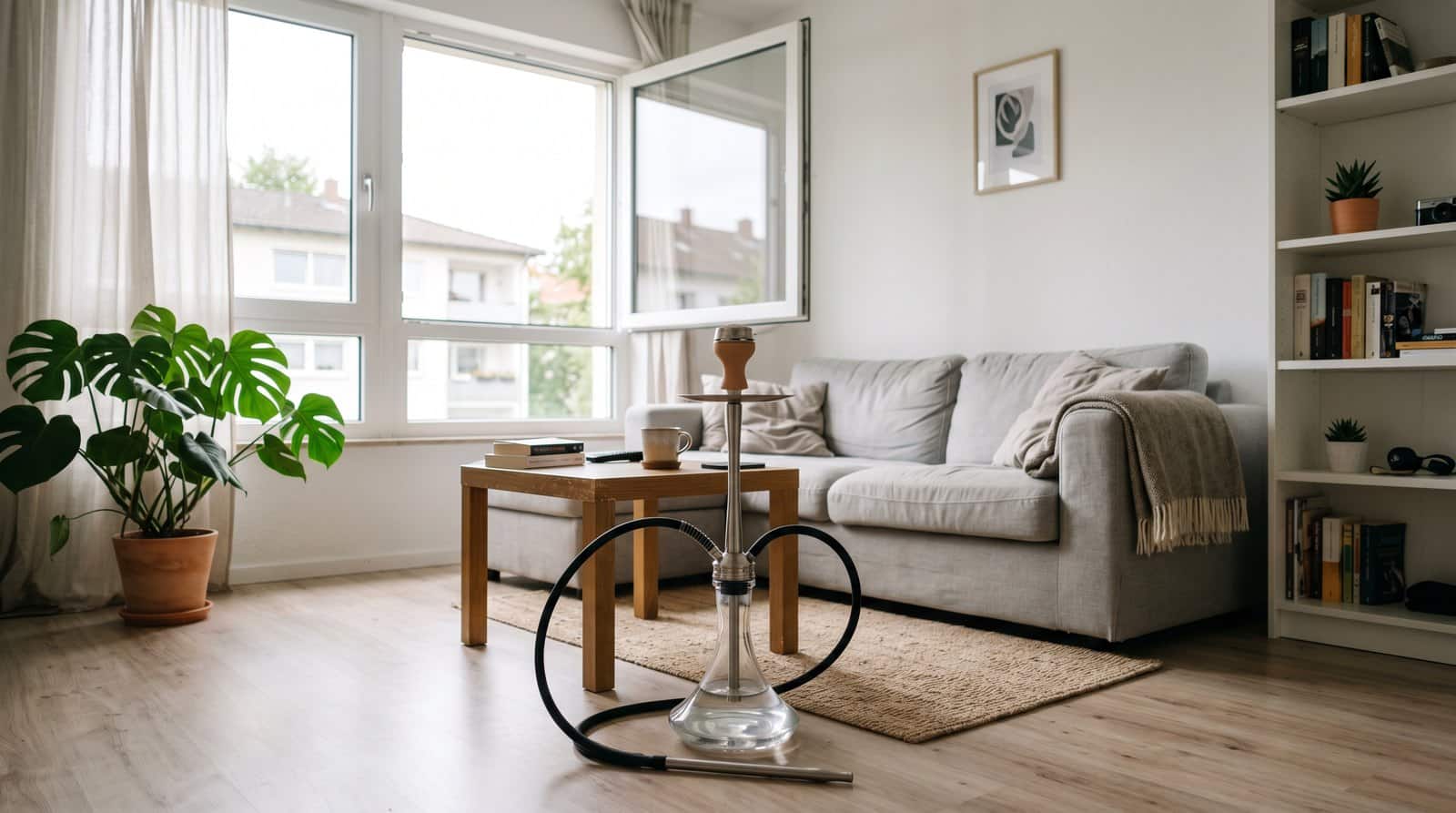
Short & honest: In the Smoking shisha is generally permitted in your own apartment and on your own balcony – it is part of the contractual use (§ 535 BGB). Above all, this sets boundaries Consideration for the neighbors: At more essential Harassment can be a court Time slot regulation demand (BGH, Ref. V ZR 110/14). In Holiday apartment, Airbnb and hotel However, the provider decides based on house rules - there is usually smoking there forbidden and triggers compensation. The biggest practical risk indoors is not the discoloration of the wall, but Carbon monoxide: It is invisible, odorless and is used by normal smoke detectors not recognized. Important: This text is general information, not legal advice - in the event of a dispute, it always depends on the individual case.
"Am I even allowed to smoke shisha in the apartment? And what about the balcony if the neighbor complains?" These are two of the most frequently asked questions about the hookah - and the answers are surprisingly specific because German courts have long since clarified them. We have those real legal situation compiled: legal texts, BGH rulings and recommendations from authorities, neatly sorted by type of housing. These are the honest practical issues that no law answers: Are the walls changing color? How much does it cost to smoke in the hotel? How dangerous is carbon monoxide really?
The short answer depends primarily on who owns the rooms and whether you are disturbing anyone. You are freest in your own four walls, but most bound in other people's accommodations. This table summarizes the situation - the details are in the sections below:
| Type of living / location | Shisha allowed? | Who decides? | Consequences for violation |
|---|---|---|---|
| Own rental apartment (inside) | Yes – contractual use | Law (§ 535 BGB); Ban only by individual agreement | Only if the ban is effective: warning, termination if necessary |
| Own balcony (rental/ownership) | Yes, with consideration | §§ 906, 1004 BGB + requirement of consideration; in the case of a dispute, the court | In the event of a significant disruption: time slot regulation, omission |
| Own condominium (special property) | Yes | Art. 2 GG; § 14 WEG (consideration) | If individuals are disturbed: omission/time regulation |
| Common areas (staircase, hallway, elevator) | Mostly forbidden | Owners' association / house rules (§ 19 WEG) | Violation of house rules |
| Holiday apartment/Airbnb | Only if expressly permitted | Host (house rules/contract) | Compensation for damages, retention of the deposit |
| Hotel room (non-smoking) | No (contractual) | Hotel (household rights/accommodation contract) | Compensation for damages, termination without notice |
| Hotel lobby, bar, restaurant | No | State Non-Smoking Protection Act | Fine + house rules |
| Shisha bar / gastronomy | Partial (special rules) | State Non-Smoking Protection Act | requirements/fines; Access only from 18 |
According to the established case law of the Federal Court of Justice, smoking – and therefore also shisha smoking – is one of them contractual use the rental apartment according to Section 535 Paragraph 1 BGB. The landlord can do it for you in your apartment not simply banned. According to Section 538 of the German Civil Code (BGB), you do not have to replace normal signs of wear and tear caused by living in the home - this also includes usual traces of smoke.
This is where it comes down to Type of clause to:
Shisha becomes legal like other tobacco smoke treated - there is no special law or a separate shisha ruling. However, because a session lasts longer and smells more intensely than a single cigarette, the threshold for consideration towards neighbors can be reached more quickly in individual cases (more on that in a moment).
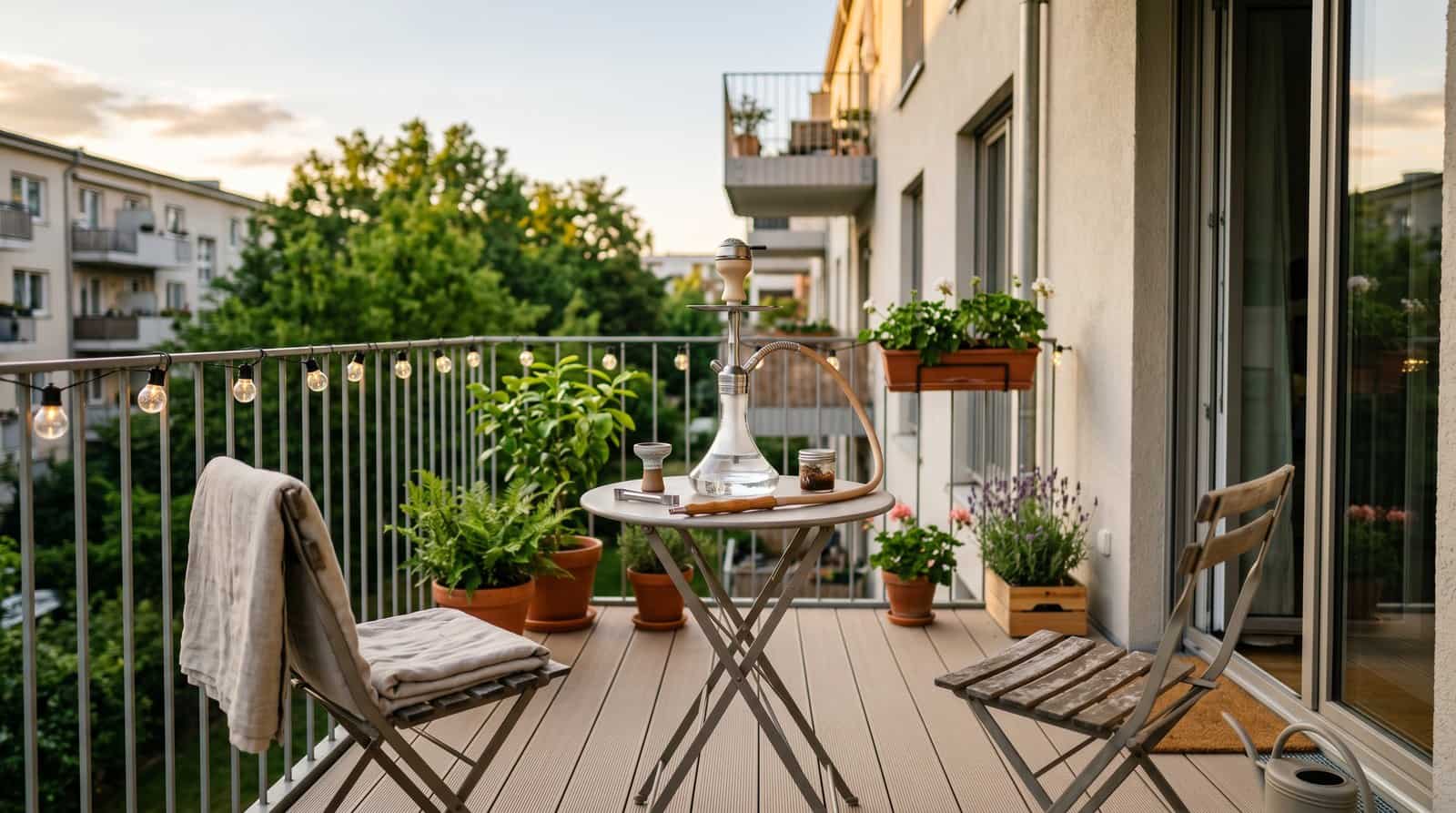
The Balcony is the classic for neighborhood disputes – and there is a fundamental ruling on exactly this: BGH, judgment of January 16, 2015, case number V ZR 110/14. It was about cigarette smoke between two tenants, but the principles also apply to shisha. The legal lever is the emission regulations of the BGB (§§ 906, 1004 and – between tenants – § 862 BGB): Tobacco smoke is an “immission” that can be defended against under certain conditions.
What is crucial is the term “significant impairment” (§ 906 BGB). The benchmark is not the subjective feeling of the disturbed, but of one understandable average people. There are no fixed limits for smoke and odor - it remains to be considered on a case-by-case basis based on type, intensity, frequency and time of day. It follows:
According to the BGH, in the event of a significant disruption it usually amounts to one Regulation of use according to time periods In addition: The disturbed neighbor must be given times in which he can use the balcony without smoking, and the smoker will be given times to smoke. The BGH deliberately does not specify fixed nationwide times – that depends on the individual case. Instance courts have assessed the threshold differently: the Hamburg Regional Court (Az. 311 S 92/10) even considered a rent reduction of 5% to the landlord to be justified in the case of intensive smoking.
Unlike the cigarette, the shisha works with you open, glowing coal (around 250-400°C). When there is wind there is a real one Risk of flying sparks and fire. And this is where the legal assessment shifts: If glowing pieces of coal, sparks or ash fall onto the neighboring balcony and cause damage (burn holes in the awning, upholstery, laundry), it is no longer a question of tolerating “imponderable” emissions.
Flying sparks and fire are considered so-called under civil law Gross emissions, which the neighbor regularly don't have to tolerate it. This can give rise to several claims: removal and omission (§ 1004 BGB), in the case of fault - including negligence - compensation (§ 823 BGB) and, under certain circumstances, a no-fault compensation claim under neighbor law (analogous to § 906 para. 2 sentence 2 BGB). The BGH has confirmed that this claim for compensation also covers fire/flying sparks (judgment of February 9, 2018, Ref. V ZR 311/16, on fire damage caused by widespread fire).
In the own house you are the most free - only the neighboring law sets limits. According to Section 906 of the German Civil Code (BGB), the neighbor must tolerate smoke, smells and soot as long as they use the property not or only insignificantly affect. Occasional, local smoking or barbecuing is to be accepted as socially acceptable; Only frequent, intensive or long-term stress can trigger a claim for injunctive relief or compensation.
Smoking in the own condominium (special property) is an expression of the general freedom of action (Article 2, Paragraph 1 of the Basic Law) and is generally permitted - there is no supreme court ruling that prohibits smoking in one's own private apartment. The distinction is important:
This is where the picture changes: In a holiday apartment or an Airbnb you only rent rooms for temporary use (Section 549 Paragraph 2 No. 1 BGB). The residential tenant protection that gives you so much freedom in your own rented apartment applies here not right now. He decides what is allowed Host about the house rules and contract – not the law.
At the hotel you have to separate two areas:
The legal basis is rental for temporary use (§ 549 BGB). Usual wear and tear is covered by the overnight price (§ 538 BGB) – non-compliant smoking But that's not the case in a non-smoking room. Consequences:
The honest answer first: Yes, tobacco smoke can yellow walls and ceilings over time and get stuck in wallpaper, plaster and textiles. This usually happens with shisha slower than with constant cigarette smoking – the tobacco doesn't burn up straight away, less precipitation per session than with chain smoking. But it is not ruled out: If used frequently in poorly ventilated rooms, odors and precipitation can become noticeable over time.
Legally, the BGH's line is clear (Judgment of March 5, 2008, Ref. VIII ZR 37/07):
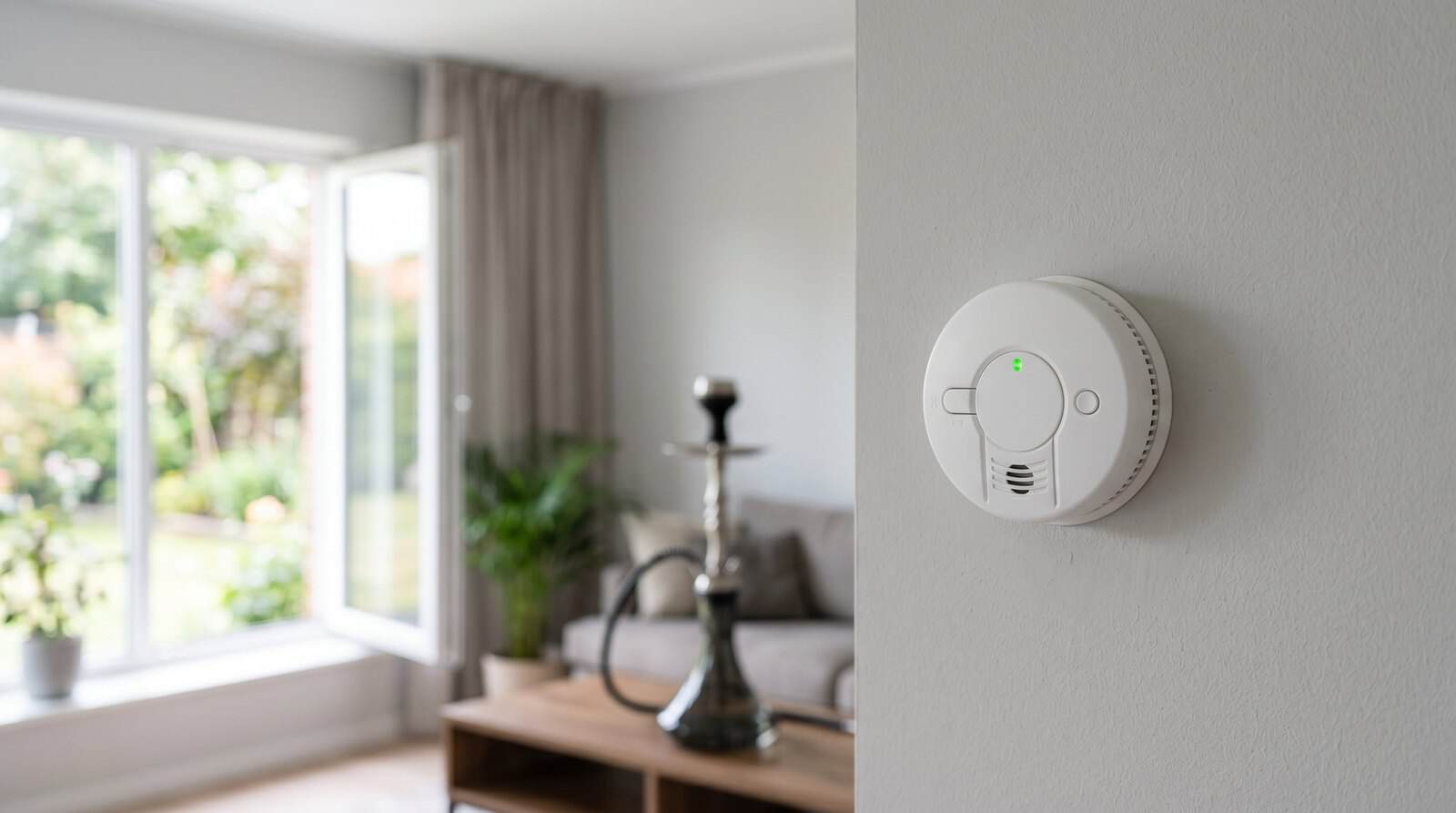
The most important safety issue when smoking shisha in the home is not the wall discoloration, but Carbon monoxide (CO). When the coal burns, incomplete combustion produces CO - the same gas that makes grilling with charcoal indoors so dangerous. The Federal Institute for Risk Assessment (BfR) makes it clear: Waterpipe smokers actually absorb significantly more carbon monoxide than cigarette smokers.
is carbon monoxide colorless, odorless and tasteless and does not irritate - the body does not show any warning reaction. That's why it is considered “silent killer”: Even dangerous concentrations are not noticed. CO binds to the red blood pigment much more strongly than oxygen and displaces it in the blood. Symptoms are non-specific – headaches, dizziness, nausea, fatigue – and are easily misinterpreted. In closed, poorly ventilated rooms this can occur acute CO poisoning come; Clinics treat such cases regularly (the Düsseldorf University Hospital dealt with around 40 shisha-related cases in 2017 alone).
You should be particularly careful Pregnant women, people with cardiovascular or lung diseases and children – CO pollution is particularly risky for them. By the way: For commercial purposes Shisha bars Strict requirements have long been in place (ventilation systems, permanently installed CO warning devices, workplace limits). There are no such obligations in a private home but the physical danger is the same. You can read more about the pollutants in detail in the guide Is smoking shisha harmful?, more about coal in the guide Light shisha charcoal correctly.
This is exactly where it starts coal-free, electric heating - and that's not just marketing, it's officially confirmed. The joint report by the state authorities on CO poisoning expressly states: “The formation of carbon monoxide from the coals is avoided when operating electrically.” Some municipalities even only allow shisha businesses with electric heating heads without complex ventilation.
A electric shisha head (e-HMD) again XKAH Pro replaces the glowing coal with an electrically controlled heating element. This means specifically:
Heating electrically instead of glowing coal: no carbon monoxide from the coal, no embers, no ash - ideal for apartments, balconies and on the go. Prices live & updated daily.
 XKAH Pro - Graphite Shisha Smokebox Original price was: 329,90€.299,00€Current price is: 299,00€.Watch now
 XKAH Pro - Graphite - Electric Smokebox + Battery Pack Original price was: 409,80€.360,00€Current price is: 360,00€.Watch now
In the guide we explain exactly how an electric shisha head works Electric Shisha Head (e-HMD). All colors, sets & spare parts are available at XKAH-Pro brand shop.
Yes. According to the case law of the Federal Court of Justice, smoking - including shisha - is generally part of the contractual use of the rented apartment (§ 535 BGB). A general ban on smoking in a pre-formulated standard rental agreement (form clause) is usually ineffective. The landlord can only effectively restrict smoking through an expressly individually negotiated agreement. However, house rules may prohibit smoking in stairwells and common areas.
In principle yes, but under the requirement of mutual consideration. The BGH (judgment of January 16, 2015, Ref. V ZR 110/14) has decided in favor of tobacco smoke on the balcony: As long as the neighbors are only insignificantly affected, they have to tolerate it. If the impairment is significant, it usually boils down to a regulation of use based on time periods - fixed times in which smoking is allowed and smoke-free times for neighbors. These principles also apply to shisha.
That depends on the intensity. The benchmark is not personal feelings, but rather those of an intelligent average person (§ 906 BGB). Mere, insignificant odor nuisance must be tolerated; If there is a significant impairment, a time limit must be agreed upon. If the neighbor demonstrates a specific health risk, the impact is always significant and should not be tolerated. However, when smoking outdoors, the BGH assumes that there is generally no specific health risk to third parties.
Smoking cannot be generally banned inside one's own apartment (special property) by majority vote - such a decision would be void due to a lack of decision-making authority (§§ 19, 23 WEG). However, the community of owners may regulate or prohibit smoking in common property (staircase, hallway, elevator, common areas) through house rules (§ 19 WEG). The landlord can only enforce a smoking ban through an individual agreement, not through a standard form clause.
This is a breach of contract. Smoking is prohibited in a holiday apartment, an Airbnb or a hotel room marked as a non-smoking room via the house rules or the accommodation contract. The provider can demand compensation for the damage actually caused (special cleaning, odor removal, loss of rent) and terminate the room without notice (§ 543 BGB). However, a flat-rate 'cleaning penalty' in the general terms and conditions is often ineffective if it does not allow proof of lesser damage (§ 309 No. 5 BGB; AG Bremen, Ref. 7 C 334/14). In addition, open coal can trigger the smoke detector and require a fire department.
Tobacco smoke can yellow walls and ceilings in the long term; With shisha this usually happens more slowly than with constant cigarette smoking, but it cannot be ruled out. Legally: As long as the discoloration can be removed through normal cosmetic repairs (painting over), it is used in accordance with the contract and does not trigger any separate compensation (BGH, Ref. VIII ZR 37/07). The tenant is only liable if the smoke has penetrated so deeply into the substance that special treatment (e.g. nicotine barrier) is necessary - and only then can the landlord keep the deposit for this.
The greatest acute danger is carbon monoxide (CO). When the coal burns, CO is created - a colorless, odorless and tasteless, poisonous gas ('silent killer') that is undetectable. Acute CO poisoning can occur in closed or poorly ventilated rooms; Clinics treat such cases regularly. Important: A normal smoke detector does not detect CO - a separate CO detector is required for this. Authorities recommend that you only smoke with coal outdoors or switch to coal-free, electric heating, which does not produce any coal CO2.
It definitely makes sense if you smoke charcoal indoors. A normal smoke alarm (mandatory in apartments) only reacts to smoke particles, not to the gas carbon monoxide. Only a CO detector according to the EN 50291 standard warns of CO in a timely manner. It belongs at breathing/head level, not on the ceiling. It is even more effective to avoid the CO source: ventilate well, only smoke outside with charcoal - or use electric/coal-free heating.
Note: This article is general, journalistically prepared information no legal advice. Tenancy law and neighborhood issues depend heavily on the individual case; In the event of a conflict, a tenants' association, Haus & Grund or legal advice can help. It is sold exclusively to people aged 18 and over - the healthiest choice is not to smoke.